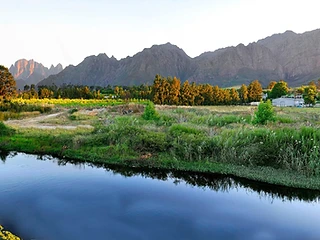
Most visitors to the Cape Winelands never make it past Paarl. That's understandable – Stellenbosch and Franschhoek are close, famous and very good at what they do. But keep driving roughly 120 km northeast of Cape Town, beyond Paarl and Wellington, and the road eventually drops into a horseshoe-shaped valley that feels like it belongs to a different century. This is Tulbagh: a small town, a big mountain backdrop, and a wine region that punches well above its name recognition.
If you're planning a summer trip and want a wine day that feels like an escape rather than a queue, here's what you need to know.
Where Tulbagh is, and why it feels so different
Tulbagh sits in a basin hemmed in on three sides by serious mountains – the Obiqua range to the west, the Groot Winterhoek to the north and the Witzenberg to the east, with peaks climbing above 1,500 m. Only the southern side is open, and that's where the cooling south-easterly finds its way in on hot summer afternoons.
The result is a valley with genuine personality. Summer days are hot (35°C is not unusual), but cold air sliding off the mountains at night can drop temperatures dramatically. For wine, that big day-to-night swing is a gift: it helps grapes hold on to their freshness and acidity, which is a large part of why the area produces such good sparkling wine and whites alongside its richer reds.
It also means the landscape changes quickly. Valley-floor vineyards give way to slopes and foothills, and on a clear day the mountains are close enough to feel like part of the tasting room décor.
Church Street: the town that rebuilt itself
Before you taste anything, take a slow walk down Church Street. It's lined with whitewashed Cape Dutch, Edwardian and Victorian buildings and is often described as having one of the largest concentrations of provincial heritage sites on a single street anywhere in South Africa.
What makes it more remarkable is that much of it had to be rebuilt. In September 1969 an earthquake badly damaged the town, and many of the historic Church Street buildings were destroyed. A dedicated restoration effort followed, and what you see today is the result: a street that looks effortlessly old but was, in fact, painstakingly put back together.
It's an easy, flat stroll, ideal for stretching your legs after the drive and before the first tasting.
What to drink in Tulbagh
Tulbagh is officially a Wine of Origin district, but it doesn't have one single party trick. A few styles stand out.
Cap Classique
If Tulbagh has a calling card, it's bottle-fermented sparkling wine. Twee Jonge Gezellen, home of Krone, is one of the names most associated with Cap Classique in South Africa, and the Krone family is also credited with pioneering night harvesting in the Cape – picking in the cool of the night to keep fruit fresh. A tasting here is a good way to understand why bubbles and this valley get along so well.
Shiraz and Rhône-style reds
Those hot days do good things for red grapes, and Shiraz has become the modern red flagship of the district. Saronsberg is widely regarded as a benchmark for Tulbagh Shiraz, and it's a natural stop for anyone who likes their reds with structure and a bit of spice. Keep an eye out for blends using other Mediterranean varieties too – they're increasingly part of the local story.
Chenin Blanc and Pinotage
Chenin Blanc is Tulbagh's most planted white, and it's worth tasting in a region where it isn't competing for attention with a dozen glossier neighbours. Rijk's is known for its focus on Chenin Blanc and Pinotage, so it's a good place to taste two very South African grapes side by side.
Small family cellars
Part of Tulbagh's charm is its scale. Alongside the better-known names you'll find smaller estates such as Lemberg, Manley and Montpellier, which add to the variety and tend to give visits a relaxed, personal feel. The Tulbagh destination page is a good starting point for seeing which estates fit your plans.
Planning a summer visit
Tulbagh rewards a little planning, especially between November and February.
- Start early. The valley heats up properly by mid-afternoon. Aim to be tasting by late morning and save the shady lunch spot for the hottest part of the day.
- Don't try to do it as a quick add-on. It's around an hour and a half from Cape Town depending on traffic, so treat Tulbagh as a full day rather than squeezing it in after Stellenbosch.
- Keep it to three or four estates. Distances between farms are manageable, but the pleasure here is in slowing down. Rushing a valley this peaceful rather misses the point.
- Consider staying over. Several estates and guesthouses offer accommodation, and a night in the valley lets you see the mountains at sunset and the stars without city light. Browse our Winelands accommodation for ideas.
- Leave the driving to someone else. Between the distance from Cape Town, mountain passes and the tastings themselves, a private driver makes the day far more enjoyable – and far safer.
- Check festive-season dates. Some estates close or have limited hours around Christmas and New Year, so if you're visiting in December, plan ahead rather than taking your chances on the day.
Pairing Tulbagh with other regions
Because it's further out, Tulbagh pairs nicely with a broader Winelands itinerary. Many visitors spend a day in the classic routes of Stellenbosch or Franschhoek, then dedicate another to Tulbagh for a complete change of pace. If you enjoy the independent, slightly rugged character of the West Coast side of the Winelands, the neighbouring Swartland makes a good companion on a longer trip. You can compare all the regions on our Cape wine routes page.
Why a private tour works best for Tulbagh
Scheduled group tours tend to focus on the regions closest to Cape Town, which is exactly why Tulbagh stays relatively quiet. To see it properly, a private, chauffeured day is the most practical option: you set the pace, choose the style of estates you prefer – sparkling, big reds or small family cellars – and nobody has to worry about the drive home.
Tell us what you like to drink and when you're travelling, and we'll suggest a Tulbagh day built around it, with tastings arranged on your behalf.
Ready to plan your Tulbagh wine day?
Browse our wine tours for inspiration, or send us a message on WhatsApp (+27 60 013 3345) and we'll help you put together a day that suits you. There's no deposit required to enquire – just tell us your dates and what you'd love to taste.