Ask a Cape winemaker where the most exciting bottles of the last twenty years have come from, and there is a good chance the answer will be the Swartland. Yet most visitors never make it there. They do Stellenbosch, they do Franschhoek, they fly home happy, and they miss the region that quietly rewrote the rules of South African wine.
That is a shame, because the Swartland is roughly an hour's drive north of Cape Town and feels like another country: rolling wheat fields, olive groves, small family cellars, and a refreshing lack of pretence. If you have already ticked off the classic Winelands and want something with a bit more character, this is where we would point you next. And with late spring settling in, now is a very good moment to plan it.
Why the Swartland is different
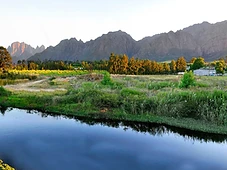
The name translates as "black land". The landscape is wide and open rather than mountainous and manicured, and much of it is given over to grain. Vineyards sit between the wheat and canola, often on slopes around the Kasteelberg and the Paardeberg.
What makes the wine interesting is the way it is grown. Bush vines have been the traditional way of farming here since the 1800s: low, free-standing vines without trellises, many of them dry-farmed without irrigation. They produce small crops of small, concentrated berries, and a generation of independent winemakers has built its reputation on what those old vines can do. Soils vary from granite to shale, clay and slate, which is part of the reason two Chenins from neighbouring farms can taste remarkably different.
What you will be tasting
- Chenin Blanc, often from old bush vines, and frequently the star of the show.
- White blends in a Rhône and Mediterranean style, with varieties such as Grenache Blanc, Roussanne, Marsanne and Viognier.
- Syrah (Shiraz), Grenache and Mourvèdre, the backbone of the region's reds.
- Cinsault and Portuguese varieties such as Tinta Barocca and Touriga Nacional, which give some Swartland reds their savoury, distinctive edge.
If you think you know South African wine from a Stellenbosch Cabernet, the Swartland will happily recalibrate you.
The three corners worth knowing
The Riebeek Valley
Riebeek Kasteel and Riebeek West are the region's social heart: two small villages beneath the Kasteelberg, with restaurants and tasting rooms within easy reach of each other. It is the most natural base for a first visit.
Estates to know here include Allesverloren, regarded as the oldest wine estate in the Swartland and long associated with Portuguese varieties and robust reds; Kloovenburg, known for its Shiraz and its olive products; Kasteelberg Vineyards, working with Rhône-style Shiraz and Chenin Blanc from the mountain slopes; Pulpit Rock, a relaxed, family-run winery at the foot of the Kasteelberg; Meerhof, which pairs tastings with a restaurant; and Riebeek Valley Wine Co. (Riebeeck Cellars), a producer founded in 1941 that works with local family growers and has a tasting room in the village.
The Paardeberg
Closer to Cape Town, the Paardeberg is granite country and home to some of the region's most talked-about names. AA Badenhorst Family Wines on the historic Kalmoesfontein farm combines tastings with farm-style dining and accommodation, making it an easy place to slow down. Dragonridge is a small organic producer focused on natural, minimal-intervention wines, with tastings by arrangement.
Voor-Paardeberg
In the neighbouring Voor-Paardeberg ward, Leeuwenkuil Family Vineyards is run by the seventh generation of the Dreyer family and offers appointment-only visits that can include a cellar tour with the winemaking team, a vineyard walk and tastings straight from tank or barrel. It is one for the wine lover who wants to get under the bonnet.
When to go (and why now is good)
The Swartland is very hot in summer and properly cold in winter. The more comfortable months run from roughly March to November, which makes late October and November a sweet spot: the vines are green, the days are long, and you are visiting before the peak summer heat turns the afternoons into a test of endurance.
If you are planning for December or January, it is still very doable. Just start early, keep the outdoor parts of the day to the morning, and build in a long, shaded lunch. Our vineyard calendar is a handy guide to what is happening in the vines in each month, from budburst to harvest.
Practical tips for a Swartland day
- Book ahead. Many of the best Swartland producers are small, family-run cellars, and several only receive visitors by appointment. Walking in on spec works at some farms but not at others.
- Do not try to do it all. Distances between farms are larger than in Stellenbosch. Three estates, with a proper lunch in the middle, is a full and very enjoyable day.
- Pick a theme. Old-vine Chenin, Rhône-style reds, or natural wine all make excellent threads to follow. A focused day teaches you far more than a scattergun one.
- Leave the driving to someone else. It is a round trip of well over 100 kilometres from Cape Town, on country roads, after several tastings. Enough said.
- Bring a cooler bag. Many of these wines are made in small quantities and can be hard to find in city shops, and the olive oil is worth the boot space too.
Combine it with the West Coast
The Swartland sits neatly beside two other regions that are easy to fold into a longer trip. Darling, towards the coast, has its own small cluster of cellars, while Tulbagh, ringed by mountains to the east, makes a lovely overnight extension. If you have two or three days, an unhurried loop through all three is one of the most rewarding wine trips in the Western Cape.
Is the Swartland right for you?
It is a strong fit if you have already done the classic Stellenbosch and Franschhoek circuit, if you prefer farm tables to formal tasting rooms, or if you simply want to taste where South African wine is heading next. It is perhaps less suited to a very first, short visit to the Cape, when the polish and proximity of the closer valleys are hard to beat.
For a closer look at the region, start with our Swartland destination guide.
Plan your Swartland wine day with us
Our private wine tours are built around your tastes, with your own guide, hotel pick-up in Cape Town and no group to keep pace with. Tell us you would like to explore the Swartland and we will help you shape a day around the producers and styles that interest you.
Browse all of our wine tours, or message us on WhatsApp at +27 60 013 3345. There is no deposit required to enquire, so you can ask all your questions before committing to anything.